Person-Centred Fire Risk Assessments: What Responsible Persons Need to Understand in 2026
Introduction
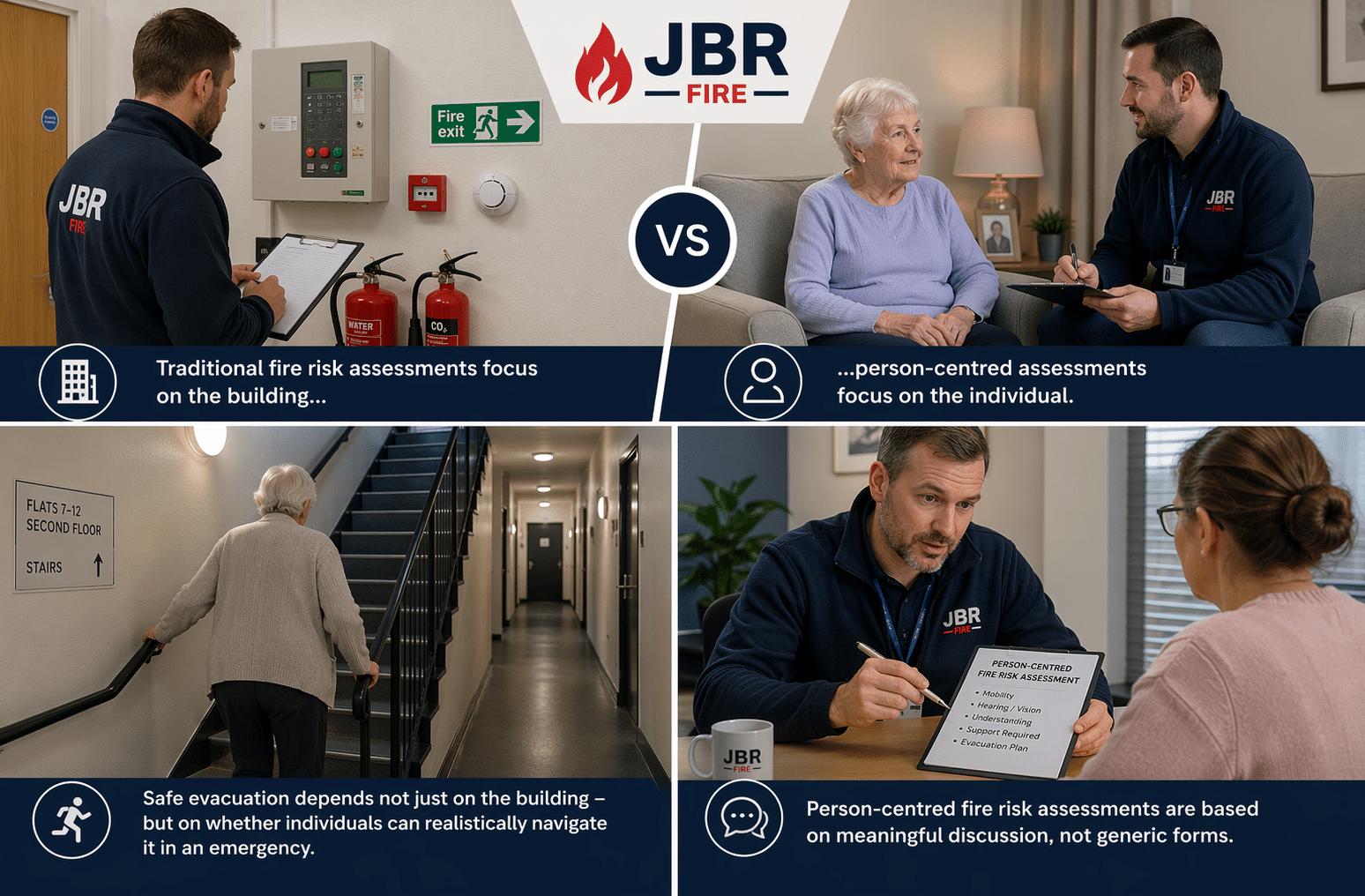
Fire risk assessments have traditionally focused on buildings; their construction, fire precautions, and means of escape – This approach assumes occupants are able to respond and react to fire in a safe way. However, recent changes to fire safety legislation in England are shifting this approach. Increasingly, the focus is not only on the building itself, but on the people within it particularly those who may be more vulnerable in the event of a fire requiring Person-Centred Fire Risk Assessments to be completed.
What is a Person-Centred Fire Risk Assessment?
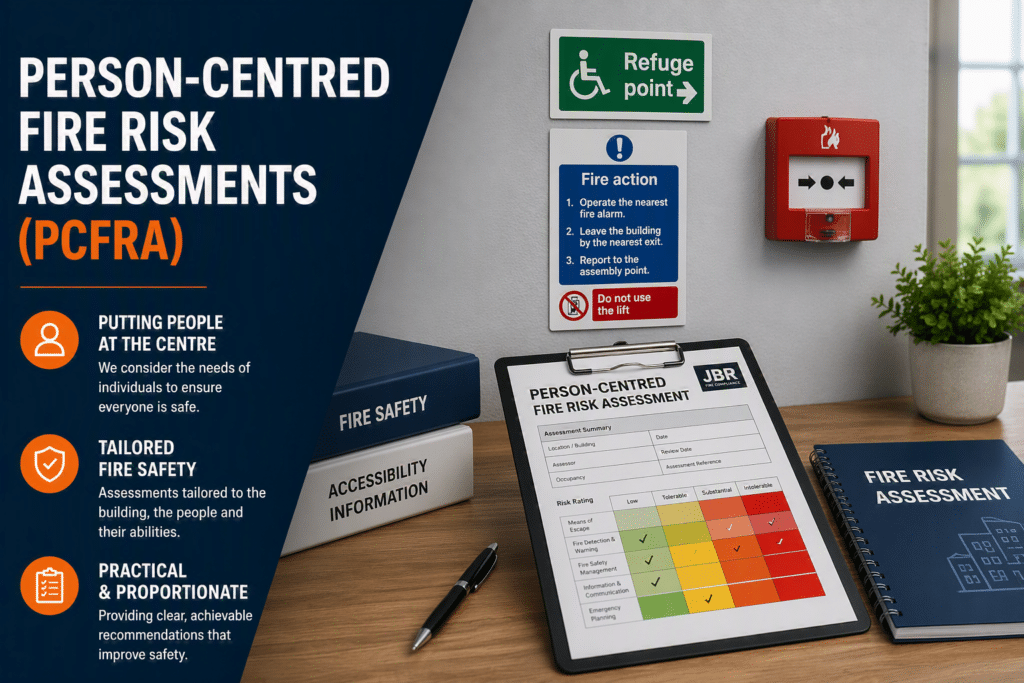
A person-centred fire risk assessment is a specific assessment process that take into consideration the requirements an induvial may have, how they will respond, how they will react and whether they can make a safe escape.
In simple terms, it asks:
If there is a fire, can this person realistically get to a place of safety?
So, why do we need this?
A normal fire risk assessment only works well if occupants are generally able to self-evacuate but issues come to light for individuals who cannot evacuate without assistance, which could be due to matters such as not being able to hear the fire alarm, or reliance on others to support their mobility.
How do we complete a PCFRA
We take a proportionate consideration of the individual taking into consideration;
- How the person would become aware of fire.
- Whether they have capacity to understand fire procedures.
- Whether they can physically get out unaided
- Whether assistance will be required.
- Do the current arrangements support the fire strategy.
This is most often achieved through meaningful discussions with responsible, and relevant persons.
Where Person-Centred Assessments Are Most Relevant
These assessments are particularly important in;
- Supported housing and assisted living environments
- Buildings with vulnerable or elderly residents
- Situations where care or support is provided
- Residential blocks where a stay put strategy is in place
They are also increasingly expected in higher-risk residential buildings where evacuation cannot be assumed.
Relationship with Evacuation Planning
Where concerns are identified, a person-centred assessment may lead to:
- A documented plan outlining what the individual should do in the event of a fire
- Consideration of whether additional measures are required
- Further discussion between the responsible person and the individual (or their representative)
Importantly, any measures should be reasonable, proportionate, and achievable.
A Common Issue in Practice
One of the most common problems seen in assessments is the assumption that:
“The building is safe, so the occupants must be safe.”
This is not always true.
A building may fully comply with fire safety guidance, but still present a significant risk to individuals who:
- Cannot evacuate without support
- Would not respond to a fire situation
- Are reliant on others who may not be present at all times
Person-centred assessments address this gap.
Review and Ongoing Management
Risk is not static and changes in the occupant requires reviews. Failure to review means that assessments become out of date and no longer relevant, which is why all risk assessments must be kept under review, a ‘living document’
Why does this matter for Responsible Persons
For those managing buildings, particularly residential or supported accommodation, the expectation is changing.
It is no longer sufficient to demonstrate that:
- Fire doors are compliant
- Alarms are installed
- Escape routes are protected
You must also be able to show that:
- The people at greatest risk have been considered
- Arrangements are appropriate for their specific needs
This is ultimately about ensuring that fire safety measures work in practice, not just on paper.
Conclusion
Person-Centred Fire Risk Assessments represent a practical and necessary development in fire safety.
They do not complicate the process unnecessarily. Instead, they ensure that assessments are realistic, proportionate, and focused on actual risk to life.
For Responsible Persons, the key message is simple:
Understanding the building is no longer enough you must also understand the people within it.
For help and support with your fire safety arrangements you can reach out to JBR Fire by clicking here