Fire Risk Assessments in Lancashire & North-West
JBR Fire Compliance — fire risk assessments in Lancaster, Preston, Kendal, Blackpool, Manchester, Liverpool, Lancashire & the North West.
Commercial Fire Risk Assessments
A fire risk assessment is not a checklist exercise. It is a full review of how, and whether the measures you already have in place would give people time to escape.
JBR Fire Compliance carries out professional fire risk assessments for offices, factories, shops, warehouses, residential blocks, HMOs and serviced accommodation across Lancashire, Cumbria, Greater Manchester, Merseyside and the wider UK.
As a commercial property owner or Responsible Person, you must have a valid, up-to-date fire risk assessment. It is not a ‘get and forget’ document. It is a living record that must change as the building, occupancy, work processes, and legislation change.
Fire safety law is hardest to manage in high-risk and multi-occupancy buildings. That is why you need a partner who stays with the building after the report is issued. We will always be there for any customer, past or present, to advise and assist so the assessment does not go out of date.
Our qualifications include ABBE Level 4 Certificate in Fire Risk Assessment & Nationally Accredited Fire Risk Assessor Register (NFRAR) Tier 3 Registered Assessor. Tier 3 is the highest level of registration available, recognising assessors as competent to assess complex and higher-risk premises.
Contact our team today to discuss your requirements & find out how we can work together! Give us a call on 07742 105 368, 01524 932 013, send us an email to info@jbrfirecompliance.co.uk or use our quick online form, and a member of our team will get back in touch with you as soon as possible.
Tell us about your property and requirements and we will provide a clear, no-obligation quote tailored to your needs.

Type 1 Fire Risk Assessment
A Type 1 fire risk assessment is the usual starting point for the common parts of a residential building. It is non-destructive. We inspect the shared areas — lobbies, stairwells, hallways, risers, bin stores and plant rooms — without opening up walls or ceilings.
- Potential Hazards: Identify ignition sources and combustible materials.
- Protection Measures: fire doors, emergency lighting, detection and alarm provision, and compartmentation that can be seen without opening-up
- Management Systems: maintenance records, policies and how fire safety is actually run day to day
The purpose is simple: confirm that a protected escape route is available and that the fire safety measures support the building’s evacuation strategy.
Type 1 does not inspect inside individual flats. If compartmentation or in-flat detection is in doubt, a Type 3 is usually the next step.
To ensure a protected escape route is available to all occupants and that fire safety measures support the building’s evacuation strategy.
Type 3 Fire Risk Assessment
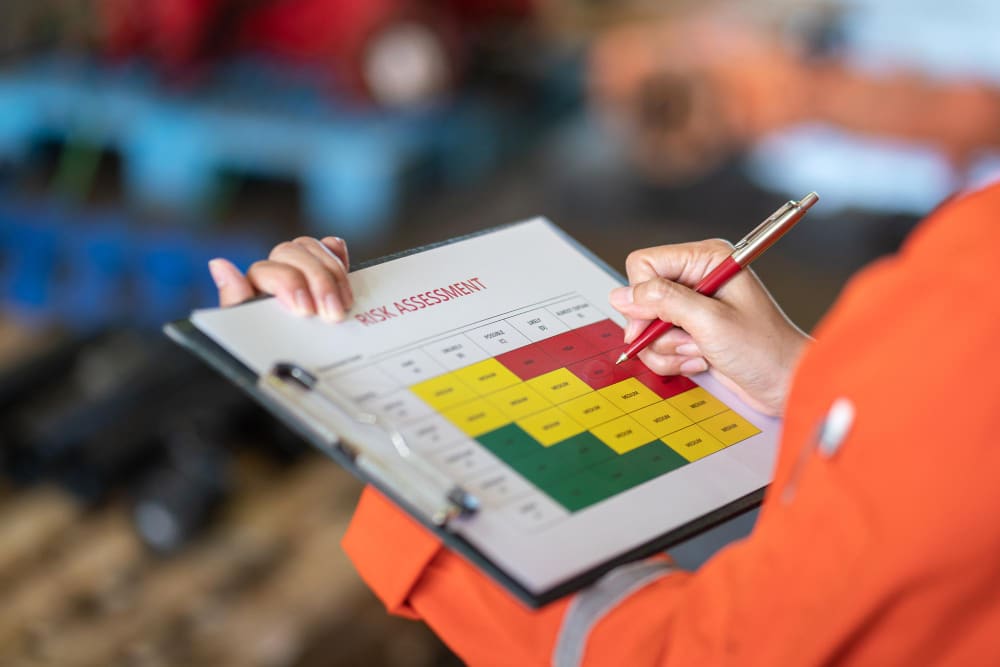
A Type 3 fire risk assessment includes everything covered in a Type 1, then goes further. After the common parts have been assessed — lobbies, stairwells, hallways, risers, bin stores and plant rooms — we also inspect a sample of private dwellings or units.
It is still non-destructive. We do not open up walls, floors or ceilings. We can usually see what we need inside the dwellings from a planned inspection of the flat entrance door, the hallway, detection, and how the unit meets the common parts.
- There is uncertainty about the structural fire-stopping between dwellings.
- The property is used as serviced accommodation or a HMO.
- You need to verify that the internal fire detection and protection within the apartments support the building’s overall "Stay Put" or "Simultaneous Evacuation" strategy.
A Type 3 is used when the safety of the block also depends on what sits behind the flat door:
- The condition of the flat entrance door from within the dwelling, including the door leaf, frame, closer, seals, glazing and ironmongery, and whether the door appears capable of providing the required fire and smoke resistance.
- Detection and warning inside the sampled dwellings, and whether that provision supports the building’s Stay Put or Simultaneous Evacuation strategy
- Visible signs of poor fire-stopping around services, hatches, boxed-in pipework and the junction between the dwelling and the common parts
- How the unit is actually used — cooking, extra occupancy, inner rooms, holiday letting or HMO-style sharing — where that changes the risk to neighbours and the escape route
- Whether residents could be expected to stay put, or whether the building now needs a different evacuation strategy
The sample represents the building, not every flat as a matter of course. Typical sampling includes different floors, different stack positions, a mix of occupied and vacant units where access allows, and any dwelling already flagged as higher risk.
Want to find out more? Contact our team today to discuss your requirements & find out how we can work together! Give us a call on 07742 105 368, 01524 932 013, send us an email to info@jbrfirecompliance.co.uk or use our quick online form, and a member of our team will get back in touch with you as soon as possible.

Understanding Type 2 & Type 4 Assessments
While Type 1 and Type 3 are the standard non-destructive benchmarks for most properties, Type 2 and Type 4 assessments are specialised, invasive surveys.
These are typically commissioned when comprehensive evidence of hidden fire-stopping is required. Often due to a building’s unique construction history, post-refurbishment verification or specific requests from local fire authorities.
- Type 2: Like a Type 1 (Common Parts), but involves destructive sampling (e.g., opening up common corridor walls or ceilings) to check the hidden fire-stopping.
- Type 4: The most comprehensive assessment, covering both common parts and dwellings with destructive sampling to verify the integrity of the building’s internal structure.
Let's secure your Building Together
Contact us today on 01524 932013 to discuss your fire risk compliance needs.