Why the 9- fire risk assessment step Process is the Gold Standard for 2026 Compliance
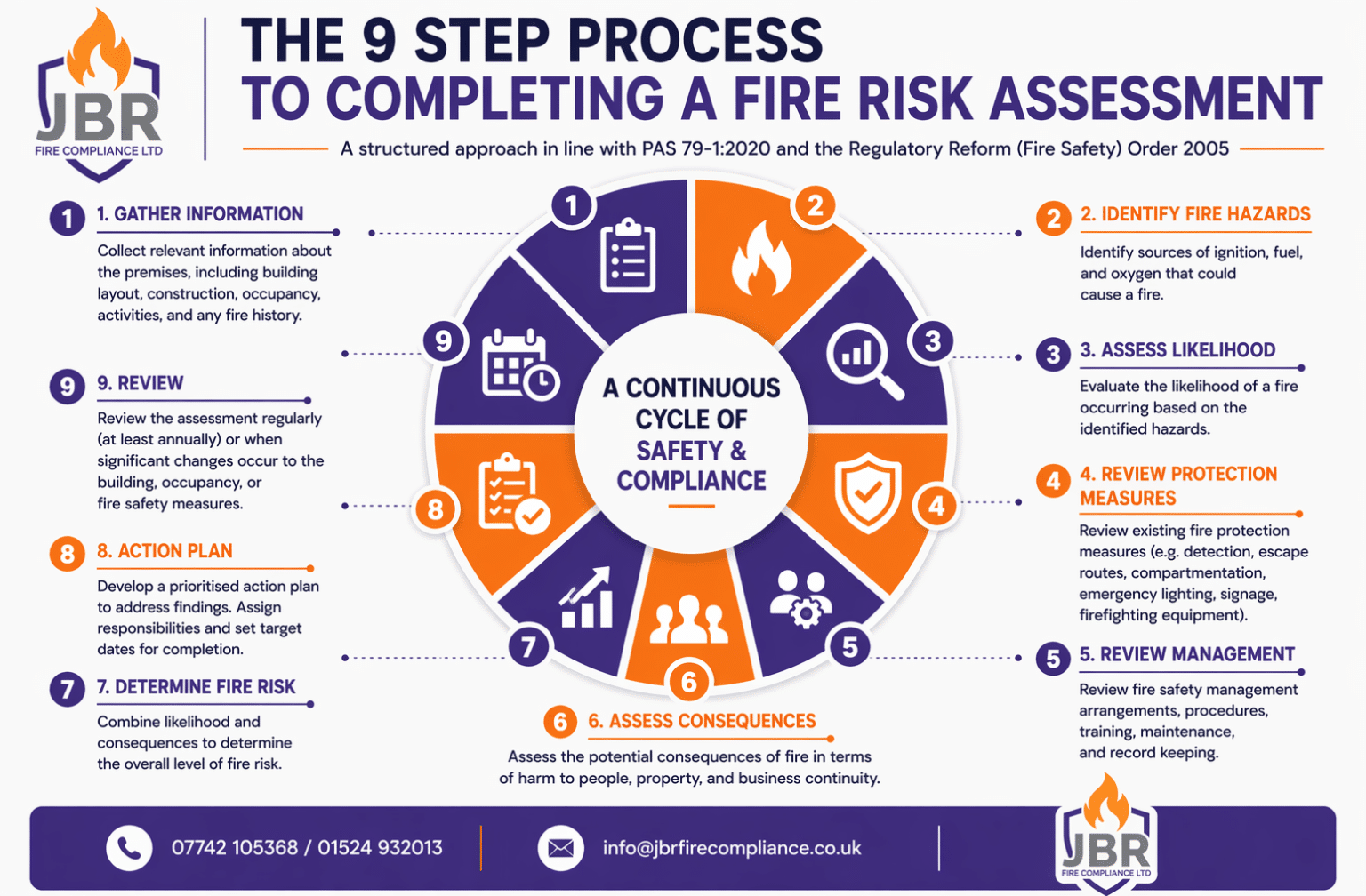
The nine fire risk assessment steps provide a structured way to identify hazards, assess risk and plan improvements. The process considers both the physical building and how people manage fire safety each day.
In this guide, we explain each step and show why a detailed assessment provides stronger protection than a basic checklist.
For years, the UK government’s “5-fire risk assessment steps” checklist was the baseline for fire safety. It was a functional starting point, but as the legislative landscape has evolved most notably with the Building Safety Act and the introduction of Section 156 the “baseline” is no longer enough.
In 2026, the industry has shifted toward the 9-Step Process, as detailed in PAS 79-1:2020 (for commercial) and BS 9792:2025 (for residential). This methodology doesn’t just look at fire hazards; it audits your entire fire safety management system.
The Evolution of the Fire Risk Assessment
The 5-step process was reactive. The 9-step process is predictive. It requires the “Responsible Person” to account for not just what is in the building, but how people behave and how the building is managed daily.
- Information Gathering
The foundation of any FRA. This isn’t just a walk-around. You must gather all of the information: building age, construction materials, occupancy profile and any relevant fire safety history.
- Identify Fire Hazards
Standard hazards remain (ignition, fuel, oxygen), but 2026 brings new risks. We now pay close attention to Lithium-Ion charging stations and high-density electrical loads from modern tech infrastructure.
- Assess Fire Likelihood
From observation to judgment. Based on your hazards, how likely is a fire to start? A well-maintained office with regularly tested electrics has a lower “Likelihood” than a workshop using damaged equipment and poor storage practices.
- Review Fire Protection Measures
This is the “Hardware” check.
- Detection: Does the fire alarm support the evacuation strategy for the building?
- Compartmentation: This is critical. Are your fire doors in a good state of repair, and are there any breaches in fire-resisting construction.
- Review Fire Safety Management
The most common point of failure. This step audits your training records, the frequency of your fire drills, and your maintenance logs. In 2026, if it isn’t recorded, it didn’t happen.
- Assess the Consequences to People
If a fire starts, what happens next? This step considers the “Human Factor” the physical ability of occupants to evacuate and the speed at which fire and smoke will travel through the specific layout of your building.
- Determine the Fire Risk
By calculating Likelihood (Step 3) x Consequence (Step 6), we arrive at an objective Risk Level. This creates a clear priority list for the building owner.
- The Action Plan
A professional FRA must result in a clear prioritised action plan these actions must have realistic timescales with clear outcomes.
- The Review Date
A fire risk assessment is a living document and should be reviewed regularly, typically on an annual basis. Reviews should also be undertaken following any significant changes to the building layout or occupancy, or after any fire-related incident or near miss.
Why 5 Steps are a Legal Risk in 2026
Under the current Section 156 reforms, the Fire and Rescue Service (FRS) can challenge the “competency” of an assessment. A basic 5-step checklist often fails to document the Management (Step 5) or the Calculation of Risk (Step 7), leaving the Responsible Person vulnerable to prosecution if an incident occurs.
Summary: The Professional Edge
Adopting the 9-step process isn’t just about avoiding fines; it’s about creating a verifiable culture of safety. Whether you are managing a small office or a high-rise residential block, the 9-step methodology provides the robust audit trail required in 2026.
Next Steps: If your building is complex, ensure your assessor is covering all 9-steps PAS 79. Your compliance, your insurance, your fire safety depends on it.
Further Information Links
- Fire Risk Assessments when discussing identifying hazards
- Fire Door Inspections when discussing passive fire protection
- Fire Sign Surveys when discussing safety signage
- Fire Evacuation Planning when discussing emergency procedures
- Fire Safety Consultancy when discussing ongoing management and compliance