
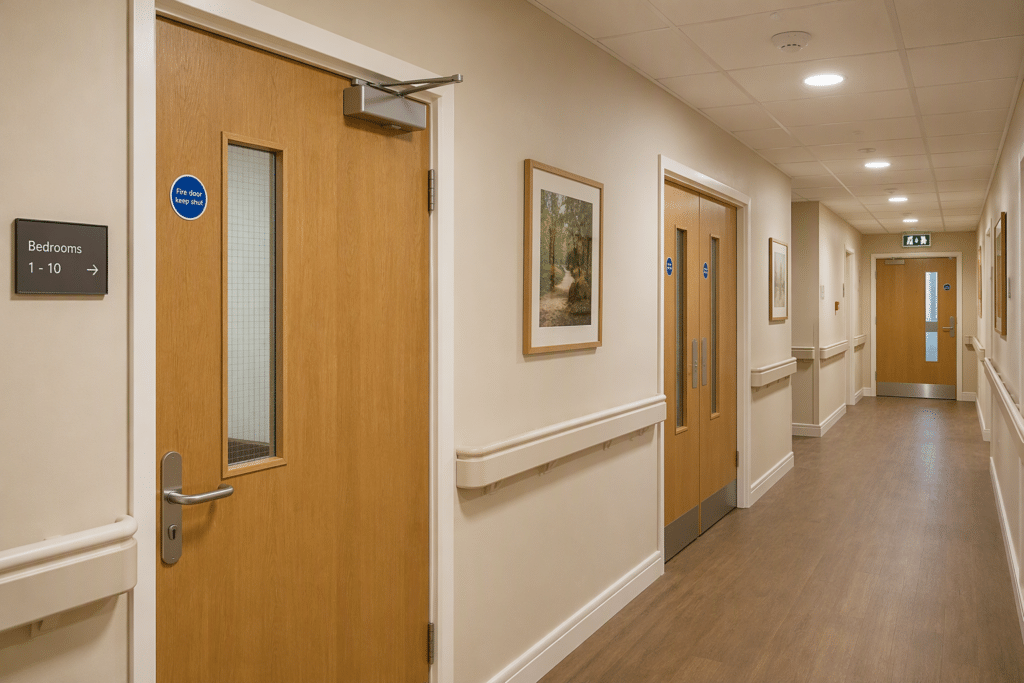
Fire Door Inspections Requirements for Care Homes: A Guide for Care Home Managers
This fire door care homes guide explains why regular inspection, maintenance and record keeping are important for protecting residents, staff and visitors. Fire door inspection requirements for care homes play a critical role in supporting compartmentation, protecting escape routes and reducing the spread of fire and smoke. In premises where occupants may have reduced mobility, cognitive impairment, or require assistance to evacuate, defective fire doors can significantly compromise the fire strategy.
Fire door inspection requirements for care homes play a critical role in protecting residents, staff and visitors within care homes, the integrity of fire compartmentation can be the difference between a minor incident and a major fire emergency. Fire doors are a key element of this strategy, helping to restrict the spread of fire and smoke while providing staff with valuable time to implement evacuation procedures.
Fire Doors Care Homes: Why They Are Particularly Important
Unlike many commercial premises, care homes often rely on progressive horizontal evacuation. This means residents may be moved from one fire compartment into another rather than immediately leaving the building. To support this strategy, fire doors must remain capable of resisting the passage of fire and smoke for their designated period of protection. Defective doors can significantly compromise these arrangements and place vulnerable residents at increased risk.
What Does the Law Require?
The Regulatory Reform (Fire Safety) Order 2005 places a duty on the Responsible Person to ensure fire precautions are maintained in an efficient state, efficient working order and in good repair. Fire doors form part of these fire precautions and must therefore be inspected, maintained and repaired as necessary.
In addition, care providers are expected to maintain safe premises under the Health and Social Care Act 2008 and associated CQC requirements. Deficiencies in fire doors may attract scrutiny during inspections and can contribute to enforcement action where significant risks are identified.
How Often Should Fire Doors Be Inspected?
The legislation does not prescribe a fixed inspection frequency for fire doors in care homes. However, industry best practice typically includes:
- Routine visual checks by staff on an ongoing basis.
- Frequent documented checks conducted by a competent member of staff.
- Formal inspections by a competent fire door inspector every six to twelve months depending on door use.
- Additional inspections following damage, alterations, refurbishment work, or reports of defects.
Because of the high occupancy levels and extensive use of doors within many care homes, six-monthly inspections are often regarded as good practice.
What Should a Fire Door Inspection Include?
A comprehensive inspection should assess:
- Condition of the door leaf and frame.
- Certificate / performance labels.
- Gaps around the sides and top of the door.
- Threshold clearances.
- Self-closing devices.
- Intumescent and smoke seals.
- Hinges and fixings.
- Glazed vision panels.
- Door furniture and locking mechanisms.
- Fire door signage.
- Hold-open devices linked to the fire alarm system.
- Evidence of unauthorised alterations or damage.
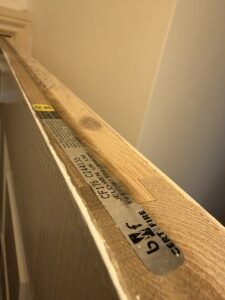
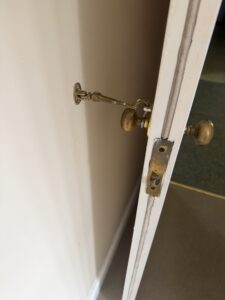
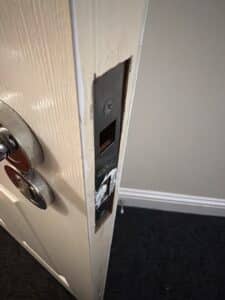
Each door should be inspected individually, recorded and any defects categorised according to risk.
Common Fire Door Defects Found In Care Homes
Fire door inspections regularly identify issues such as:
- Excessive gaps around the door.
- Doors failing to fully close into the frame.
- Damaged or missing seals.
- Defective self-closing devices.
- Doors sticking on carpets or flooring.
- Loose hinges and ironmongery.
- Missing or damaged signage.
- Fire doors wedged open using unauthorised devices.
In a recent residential care home assessment, defects included excessive gaps, doors failing to close properly, damaged hardware and doors being held open with wedges. These types of deficiencies can significantly reduce the effectiveness of fire compartmentation.
Hold-Open Devices in Care Homes
Many care homes use hold-open devices to improve accessibility and assist residents. Where fire doors need to be held open, suitable devices linked to the fire alarm system should be used. The use of wedges or other improvised methods is not acceptable, as fire doors may fail to perform when needed.
Any hold-open device should be regularly tested and maintained to ensure it releases correctly when the fire alarm operates.
Record Keeping and Compliance
Care home operators should maintain records of:
- Fire door inspection reports.
- Routine maintenance checks.
- Completed repairs and upgrades.
- Replacement certification where applicable.
- Competent person inspections.
Maintaining clear records helps demonstrate compliance and provides evidence that fire safety is being effectively managed.
Conclusion
A structured fire door care home inspection programme helps ensure defects are identified, recorded and repaired before they compromise resident safety.
Fire doors are one of the most important life safety features within a care home. Given the vulnerability of many residents and the reliance on compartmentation to support evacuation strategies, care home managers should ensure that fire doors are subject to regular inspection, maintenance and prompt repair where defects are identified. A structured inspection programme not only supports legal compliance but helps protect residents, staff and visitors from the effects of fire and smoke.
Need a fire door inspection or fire risk assessment for your care home? JBR Fire Compliance provides independent fire door inspections and fire risk assessments for care homes, and assisted living facilities throughout Lancashire, Cumbria and the North West.