Fire Safety in Care Homes: Why Evacuation Planning Matters
Fire safety in care homes relies on more than alarms, fire doors and emergency lighting. These measures are important, but they must be supported by a realistic evacuation plan that reflects the people living in the premises.
In a care home, residents may not be able to leave quickly without help. Some may have mobility issues, memory problems, medical needs or other vulnerabilities. Therefore, evacuation planning needs to consider how staff would support residents safely during a fire.
GOV.UK provides dedicated guidance for fire safety risk assessments in residential care premises, which reflects the need for care settings to take a suitable and premises-specific approach.
Why Evacuation Planning Is Different in a Care Home
In many workplaces, evacuation planning is based on people leaving the building quickly when the alarm sounds.
Care homes are different.
Some residents may need physical assistance. Others may not understand the alarm or may become distressed. In some cases, moving residents directly outside may not be the safest first step.
Because of this, many care homes rely on a managed evacuation strategy. This may involve moving residents into another protected part of the building before a full evacuation becomes necessary.
What Should an Evacuation Plan Consider?
A suitable evacuation plan should reflect the building, the residents and the staff available.
Important considerations include:
- The number of residents
- Resident mobility and dependency levels
- Day and night staffing levels
- Protected escape routes
- Compartmentation
- Fire doors
- Alarm and detection systems
- Emergency lighting
- Staff roles and responsibilities
- Assembly points or places of relative safety
- Procedures for visitors and contractors
- Communication during an emergency
The plan should be practical. It should not simply exist as a document that nobody understands.
Staff Training and Fire Procedures
Staff play a vital role in care home fire safety. Even where the building has suitable fire protection, the procedures need to be understood by the people expected to follow them.
Staff should know what to do when the alarm sounds, how to support residents, which routes to use and who is responsible for key actions.
This is especially important at night, when staffing levels may be lower. A fire risk assessment should therefore consider whether procedures remain suitable at all times, not just during the busiest parts of the day.
Fire Doors and Escape Routes
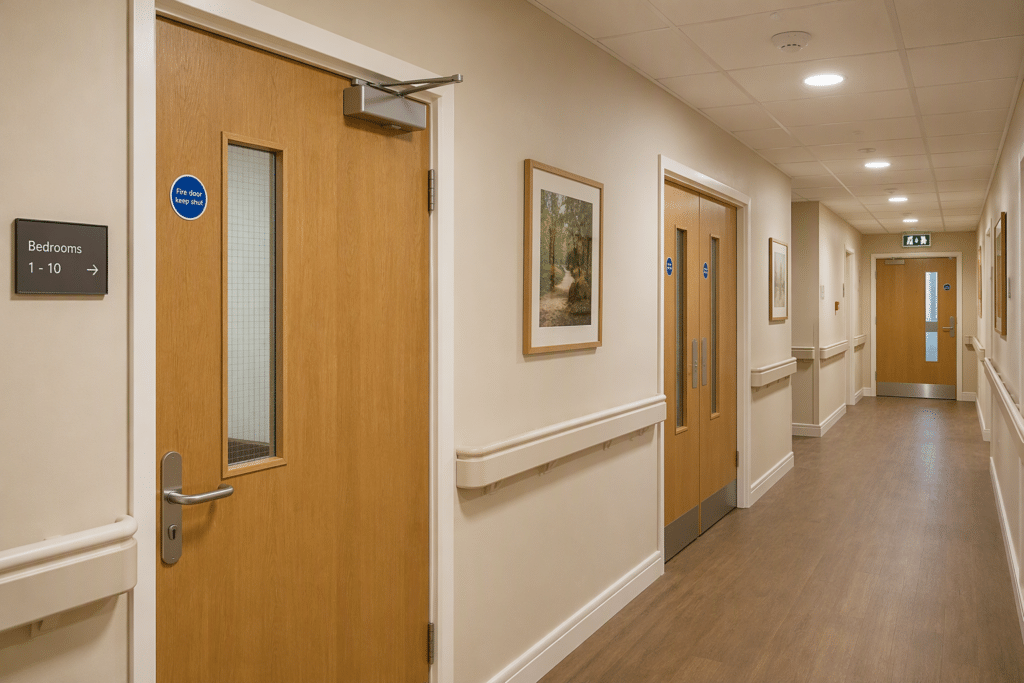
Fire doors help protect escape routes and slow the spread of smoke and fire. In a care home, this can be critical.
However, fire doors must be kept in good condition. They should close correctly, have suitable seals where required and not be wedged open.
Escape routes should also remain clear. Storage in corridors, blocked exits or poorly maintained doors can all create unnecessary risk.
Where problems are identified, the responsible person should take action to address them.
Progressive Horizontal Evacuation
Some care homes are designed around progressive horizontal evacuation. This means residents can be moved from one fire-resisting compartment to another on the same level, rather than being moved outside immediately.
This type of strategy relies heavily on the building’s compartmentation and fire doors. It also relies on staff knowing what to do.
Because of this, the fire risk assessment should consider whether the building and procedures support the intended evacuation strategy.
Reviewing the Evacuation Plan
A care home evacuation plan should be reviewed when circumstances change.
For example, a review may be needed if:
- Resident needs change
- Staffing arrangements change
- The building is altered
- Fire doors are replaced or damaged
- New risks are introduced
- Fire drills reveal issues
- The fire risk assessment identifies concerns
Regular reviews help ensure the plan remains suitable.
Support With Fire Evacuation Planning for Care Homes
JBR Fire Compliance supports care homes with professional fire risk assessments, evacuation planning and fire safety consultancy.
A clear assessment can help identify whether current arrangements are suitable and whether the evacuation strategy needs to be improved.