Lithium-ion Battery Fire Safety: Reducing Fire Risks from E-Bikes, E-Scooters and Rechargeable Devices
Lithium-ion battery fire safety is becoming an increasingly important consideration for homeowners, landlords, managing agents and Responsible Persons. Lithium-ion batteries are now found in a wide range of everyday electrical items, including mobile phones, laptops, power tools, e-bikes, e-scooters, mobility scooters and rechargeable vapes.
While these batteries are generally safe when used correctly, they can present a significant fire risk where they are damaged, poorly manufactured, incorrectly charged or stored in unsuitable locations. The risk is particularly relevant in residential buildings, HMOs, blocks of flats, serviced accommodation and other premises where escape routes may be shared by multiple occupants.
At JBR Fire Compliance Ltd, we regularly consider electrical fire risks, charging arrangements and the storage of rechargeable devices when carrying out fire risk assessments across Lancashire, Cumbria and the North West.
Why Lithium-ion Battery Fire Safety Matters
Lithium-ion batteries store a large amount of energy in a small space. When a battery is damaged, overcharged, exposed to heat or used with an unsuitable charger, it may overheat and fail rapidly.
Lancashire Fire and Rescue Service advises that lithium batteries can overheat and catch fire if they are overcharged, damaged, charged near combustible materials, used with incompatible or fake chargers, or disposed of incorrectly in general waste.
Fires involving lithium batteries can develop quickly and may produce intense heat, smoke and toxic gases. This can make them particularly hazardous where charging takes place in hallways, staircases, communal corridors or other areas forming part of an escape route.
Common Lithium-ion Battery Fire Safety Risks
During fire risk assessments, the following issues may be relevant where lithium-ion batteries are used or stored on site:
- E-bikes or e-scooters being charged in communal corridors
- Devices being charged overnight or while occupants are away
- Batteries being charged on beds, sofas or other combustible surfaces
- Use of damaged, second-hand or incompatible chargers
- Modified e-bikes or conversion kits
- Lack of management policy for communal residential buildings
- Rechargeable devices obstructing escape routes
- Poor resident communication regarding battery safety
- Damaged batteries being stored rather than safely disposed of
- Batteries or electrical items being placed in general waste bins
These issues may appear minor in isolation, but in a residential building they can significantly increase risk if a fire starts and affects the means of escape.
Charging E-Bikes and E-Scooters Safely
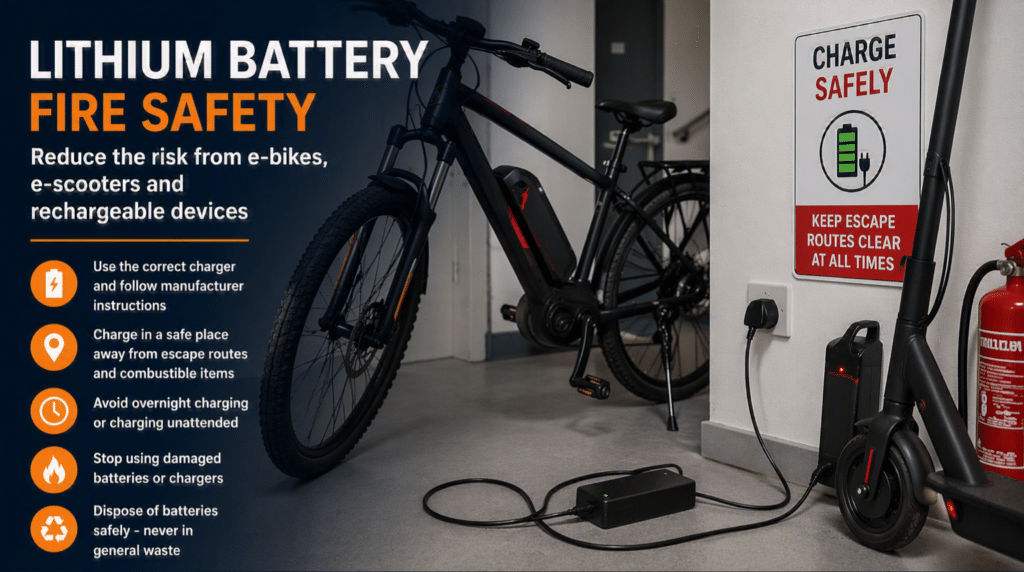
E-bikes and e-scooters can create particular concerns because of the size and capacity of their batteries. Fire services and safety organisations consistently advise that these devices should be charged carefully and away from escape routes.
NFCC (National Fire Chiefs Council) guidance states that e-bikes and e-scooters are commonly powered by lithium-ion batteries and that safe charging practices are important to avoid fires from starting in residential properties. The advice is to simply avoid storage or charging of equipment on the means of escape from any building.
Where possible:
- Use the charger supplied or recommended by the manufacturer
- Do not charge batteries overnight or when the property is unattended
- Keep batteries away from flammable materials while charging
- Avoid charging in hallways, staircases or communal escape routes
- Do not cover chargers or battery packs during charging
- Disconnect the charger once charging is complete
- Do not use damaged batteries or chargers
- Buy replacement chargers and batteries from reputable sources
Why Escape Routes Matter
One of the most important fire safety considerations is whether a fire could affect the route that occupants need to use to escape.
In blocks of flats, HMOs and converted properties, occupants may depend on shared staircases, landings and communal corridors. If an e-bike, e-scooter or battery pack catches fire in one of these areas, occupants may be unable to safely pass the fire or smoke.
For this reason, rechargeable devices should not normally be charged or stored where they could obstruct or compromise a means of escape.
This is particularly important in:
- Blocks of flats
- HMOs
- Student accommodation
- Sheltered or supported housing
- Serviced accommodation
- Buildings with single staircases
- Properties with narrow corridors or limited alternative escape routes
Damaged Batteries and Warning Signs
A lithium-ion battery should not be used if there are signs that it may be damaged or defective.
Warning signs may include:
- Swelling or bulging
- Unusual heat during use or charging
- Hissing, cracking or popping sounds
- Leaking fluid
- A strong or unusual smell
- Smoke
- Scorch marks
- Damage following a drop, impact or collision
- Charger or cable damage
Where these signs are present, the device should not continue to be charged or used. Damaged batteries should be dealt with safely in accordance with the manufacturer’s instructions and local recycling arrangements.
Safe Disposal of Lithium Batteries
Lithium batteries should not be placed in general waste bins. Batteries thrown away with normal rubbish can be damaged during collection, transport or processing, increasing the risk of fire.
Lancashire Fire and Rescue Service identifies improper disposal in general waste as one of the risks associated with lithium batteries. Local reporting in Lancashire has also linked badly disposed lithium batteries with fires at waste sites. [lancsfirer…cue.org.uk] [lancasterg…dian.co.uk]
Where possible, batteries should be recycled using appropriate battery recycling points or waste recycling centres. If a battery cannot be removed from the item, the whole electrical product may need to be taken to a suitable recycling facility.
Lithium-Ion Battery Fire Safety In Residential Buildings
In residential buildings, fire safety is not only about individual behaviour. Managing agents, landlords, freeholders and Responsible Persons may need to consider how lithium battery risks are managed within the building.
This may include:
- Advising residents not to charge e-bikes or e-scooters in communal areas
- Keeping escape routes clear from stored items and charging equipment
- Providing resident fire safety information
- Considering whether a building-specific policy is required
- Recording lithium battery risks within the fire risk assessment
- Reviewing arrangements where e-bikes, e-scooters or mobility scooters are likely to be present
- Ensuring waste and recycling arrangements are suitable
- Reviewing whether detection is appropriate in relevant areas
- Taking action where devices are stored in common parts
The Department for Transport has published guidance for premises managers on managing fire risk from e-cycle and e-scooter batteries. The guidance is intended to help managers assess and manage these risks, although it states that it is informative and does not replace existing regulations. [gov.uk]
Lithium-Ion Battery Fire Safety in Fire Risk Assessments
A suitable fire risk assessment should consider foreseeable ignition sources and fire hazards within the premises. In many residential buildings, the use and charging of lithium-ion batteries is now a foreseeable issue.
This does not mean that every building requires the same level of control. The approach should be practical and proportionate, taking into account:
- The type of building
- Occupancy profile
- Escape route arrangements
- Whether common areas are used for storage
- Whether mobility scooters, e-bikes or e-scooters are present
- Existing management arrangements
- Resident communication
- Fire detection and warning arrangements
- The likelihood of devices being charged in communal areas
For some buildings, simple resident information and clear management rules may be sufficient. For others, particularly where devices are being charged in escape routes, more immediate action may be required.
What to Do if a Lithium-ion Battery Catches Fire
Lithium battery fires can develop quickly and may be difficult to control. Lancashire Fire and Rescue Service advises not to attempt to tackle a lithium battery fire yourself, not to attempt to move a burning item, and to get out, stay out and call the fire service. NFCC guidance similarly advises that in the event of an e-bike, e-scooter or lithium-ion battery fire, people should not attempt to extinguish the fire and should get out, stay out and call 999.
If a device catches fire:
- Do not attempt to move it
- Do not put yourself or others at risk
- Leave the building if it is safe to do so
- Close doors behind you where possible
- Call 999
- Do not re-enter the building
Reducing Risk in Residential Buildings
Many lithium battery fire risks can be reduced by simple precautions.
Key steps include:
- Buying electrical items from reputable retailers
- Using manufacturer-approved chargers
- Avoiding overnight charging
- Keeping batteries away from escape routes
- Not charging on beds, sofas or combustible surfaces
- Removing damaged devices from use
- Keeping communal areas clear
- Providing clear resident guidance
- Disposing of batteries correctly
- Reviewing the fire risk assessment when new risks are identified
A proactive approach helps reduce the likelihood of fire and supports compliance with fire safety duties.
Fire Risk Assessments in Lancashire and Cumbria
JBR Fire Compliance Ltd provides professional fire risk assessments throughout Lancashire, Cumbria and the North West.
We assess a wide range of premises, including blocks of flats, HMOs, serviced accommodation, commercial premises, care settings, schools, holiday parks and residential buildings.
Where lithium battery fire risks are relevant, we can provide practical and proportionate advice to help Responsible Persons, landlords and managing agents reduce risk and improve fire safety arrangements.
Need a Fire Risk Assessment?
If you manage a residential building, HMO, block of flats, serviced accommodation or commercial premises, JBR Fire Compliance Ltd can help identify fire safety risks and provide clear recommendations.
Contact JBR Fire Compliance Ltd to arrange a professional fire risk assessment across Lancashire, Cumbria and the North West.